
denet.exe
Summary
denet.exe is a narrative-heavy, single-player Operating System Simulation-Horror game that explores the themes of nostalgia and loss. In this game, you play as Mike, a young man who stumbles upon his dusty PC, reminiscing on the good old days alongside his old online friend Dave. But…is that really Dave he is talking to?
Overview
denet.exe is the 2nd Game Project I made alongside my peers from Futuregames. At the very beginning of this project, we were given the theme of Symbiosis to incorporate into our chosen game ideas. Taking on the mantle as the narrative designer, as well as puzzle designer and level designer, I held a significant part in shaping the overall feel of the game.
My team initially approached the theming through a purely horror-focused lens, taking the parasitic form of symbiosis that is a prominent element within the genre and placing it front and center in our game in the form of possession. However, as development progressed, more focus was placed on the characters and the unsettling, nostalgic environment, with the theming now relegated to the antagonist and the main drive of the story. As my first official foray into writing a complete narrative, it was exciting to make various iterations to this game to ensure that our players would have a finished experience with little to no immersion-breaking moments.
Contributions
Narrative Design — Character dialogue, story progression, and conversation timings.
Puzzle Design — Designed and iterated on environmental/visual puzzles that reinforced the feeling of unsettling nostalgia.
Level Design — Created layouts and blockouts for the needed levels within the game.
Narrative Design
Character Dialogue
As horror primarily focuses on the players’ engagement with the environment and the characters they control within the unexplored landscape, I wanted the people playing this game to feel an intrinsic attachment and curiosity to these characters, as well as the limited amount of information given, trying to piece together the story alongside the protagonist as they discover the real truth behind Dave’s identity.
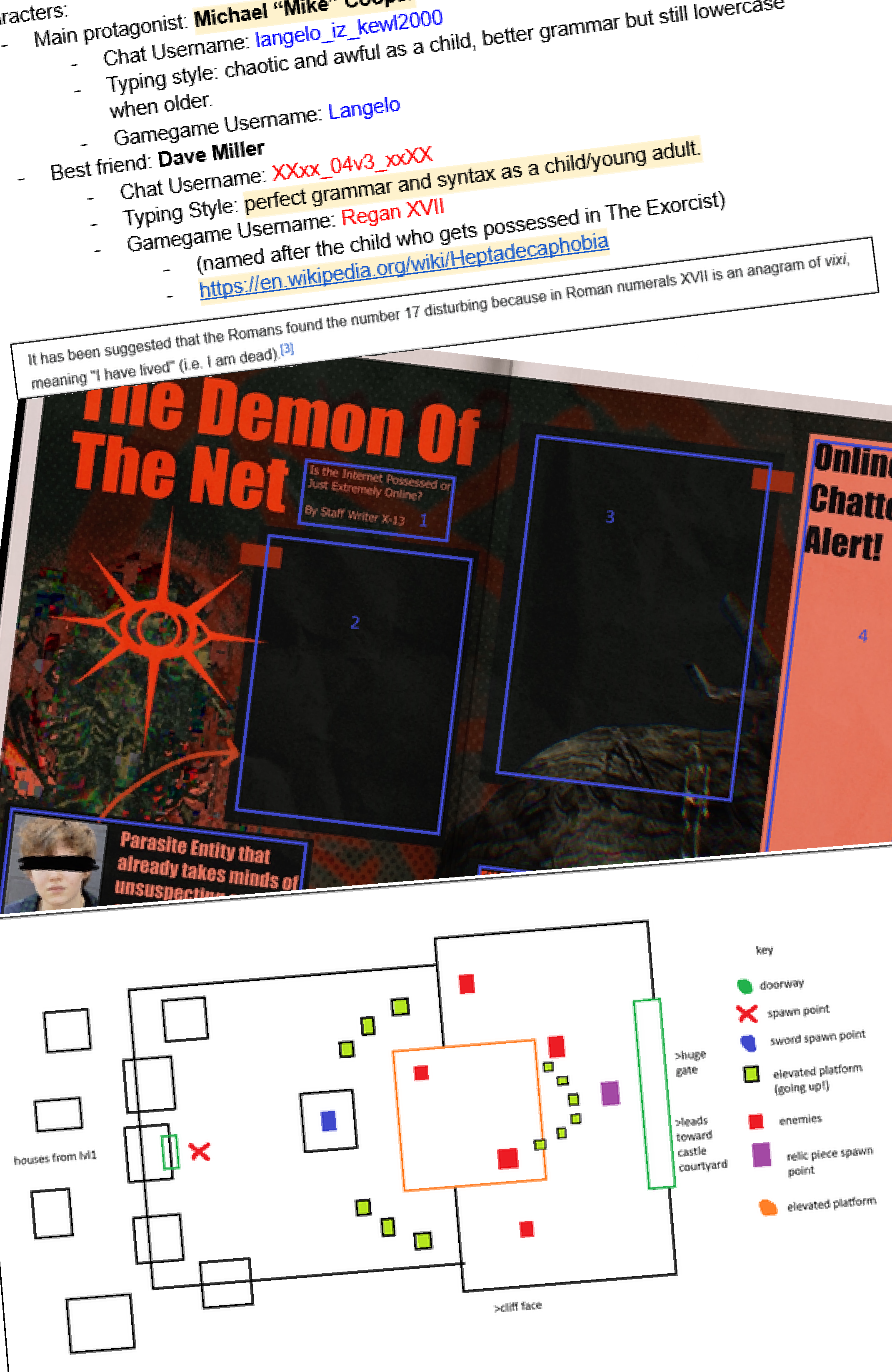
In order to streamline development, I created a few simple character sheets within Google Docs, detailing every character's names, usernames, writing quirks, date of births, and any other relevant information needed for the main cast.
To make the characters feel more alive, I took inspiration from media within the appropriate era, most notably early internet video game forums, the comment sections within pre-Google Youtube, as well as recordings from various MMORPG’s where the chat is visible; all to take note of the terminologies used within those timeframes, and to ensure authenticity.
Narrative Design Document Excerpt
Story Progression
Since the team was in agreement that we wanted the game to be a set experience, with a concrete start and finish point, I went to work in dividing up the game into several key archs. Using Google Docs, I made several iterations that showcased the bulletpoint condensations of each pass-through, and the detailed play-by-play of all the events that should happen within the game. In this sense, I also had the role of scenario writer due to how detailed each scene description ended up becoming.
Story Progression & Iteration
The initial beats of the game feel slow, using the players’ curiosity to drive the pace at whatever speed they feel comfortable in, only amping up once the player has caught up to the mechanics of the Operating System, especially when they first enter the game-within-the-game, Knights of Good and Evil IV, abbreviated to KoGaE4. Once the player has access to KoGaE4, all (metaphorical) hell breaks loose, the set narrative tugging the player along the set path until they successfully reach the end.
The biggest challenge I faced when creating all of these different iterations within the narrative, was ultimately the limited scope we had to always keep at the forefront. Wanting our game to be completed ideally within 20 minutes of playtime, many elements of the story, including branching pathways, dialogues, and ending sequences, had to be scrapped or reworked in order to fit within our production. Unfortunately, this also meant that when looking at both the story and the characters from afar, they at times fall flat due to crucial parts of the dialogue being removed or altered to an egregious degree.
If I were to continue working on this game further, I would implement the original idea of having two distinct endings, leaving the core exploration of the world to be a part of the “bad” ending, and the “good” ending focusing on solving the mystery of what happened to the real Dave.
Iteration Excerpts
Conversation Timings
Once all the Dialogue was implemented within the game, I requested one of my programmers to also add in a timing element behind each line. With the main antagonist “Dave”, I wanted the players to feel immediately alarmed by how quickly the messages were coming in, the unnatural typing style breaking the limits of believability that a regular human could produce.
While this did lend many favors for the overall pacing of the game, allowing us to add in more content for a very short amount of playtime, this also gave rise to the issue of players missing out on key dialogue points due to how fast the text was scrolling by. Adding on the issue of the scroll bars sticking to the bottom of the screen when any dialogue sequence was initiated, in some play sessions, the experience felt by the players was described as “frustrating”, “unfriendly”, and “unintuitive”, which, considering the dialogue-heavy emphasis on our game, feels fair in retrospect. If I were to continue working on this game, I would put a harder emphasis on fixing this issue, as well as ensuring the player had more agency when initiating each dialogue sequence, perhaps in letting them type out each of Mike’s messages before sending them off to “Dave”.
Before
After
Puzzle Design
At around the end of week 2 of production was when the topic of adding puzzles came into play. As our game no longer had the traditional markings of a horror game, I pitched to incorporate the desktop element back into the world of KoGaE4 via the use of password-locked files.
Puzzle Development
Originally, these files were meant to be found only when attempting the “good” route - as in the first draft, the player was intended to reach the “bad” ending by default, reaching the “good” route on the second playthrough - but as time was running short, I reworked the entire narrative so that these files were an unavoidable key element within the story. This also unfortunately meant that any careful subtleties present in previous iterations had to be scrapped in order to successfully fit within the 20min timeframe. Ideally, I would like to incorporate the puzzles and the story in its entirety if I were given a chance to continue working on this project.
Level Design
While I was rewriting huge bouts of the narrative, I also had the chance of trying my hand at creating some of the levels within the game. Using MSPaint to set the top-down layouts of the 2nd and 3rd levels, I assisted my Level Designer, Kim Milbers, in creating the blockouts in Unity, eventually collaborating on making the final variant behind lvl 3
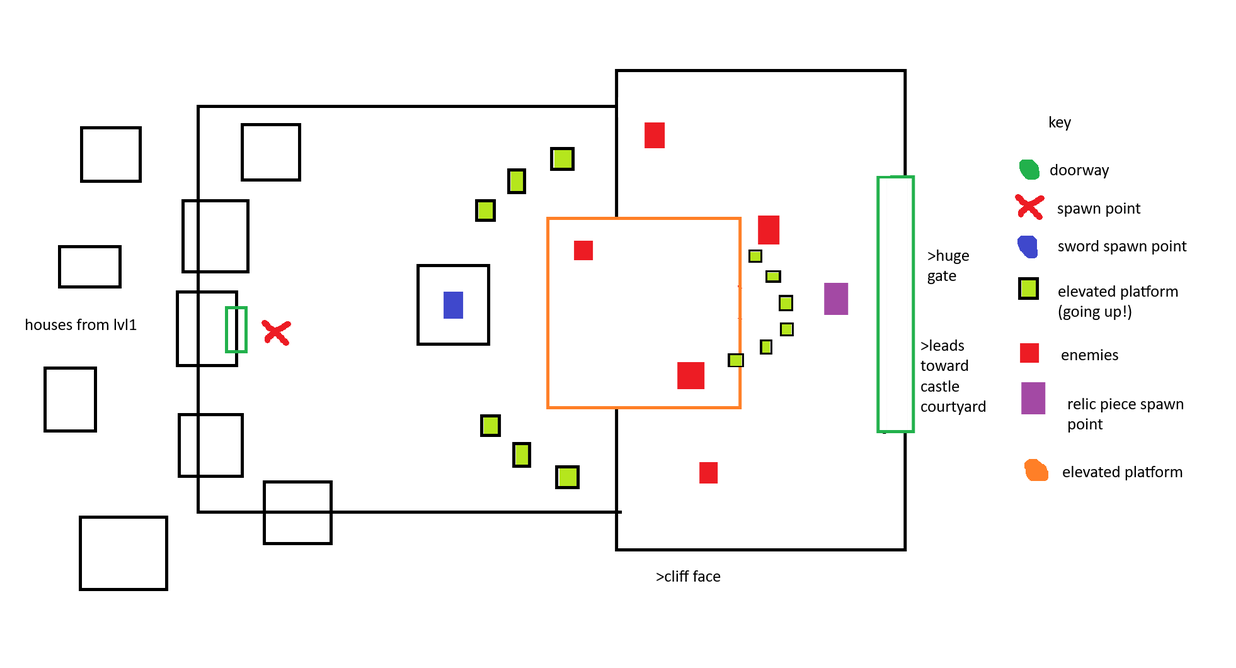
Lvl2 layout, top down view
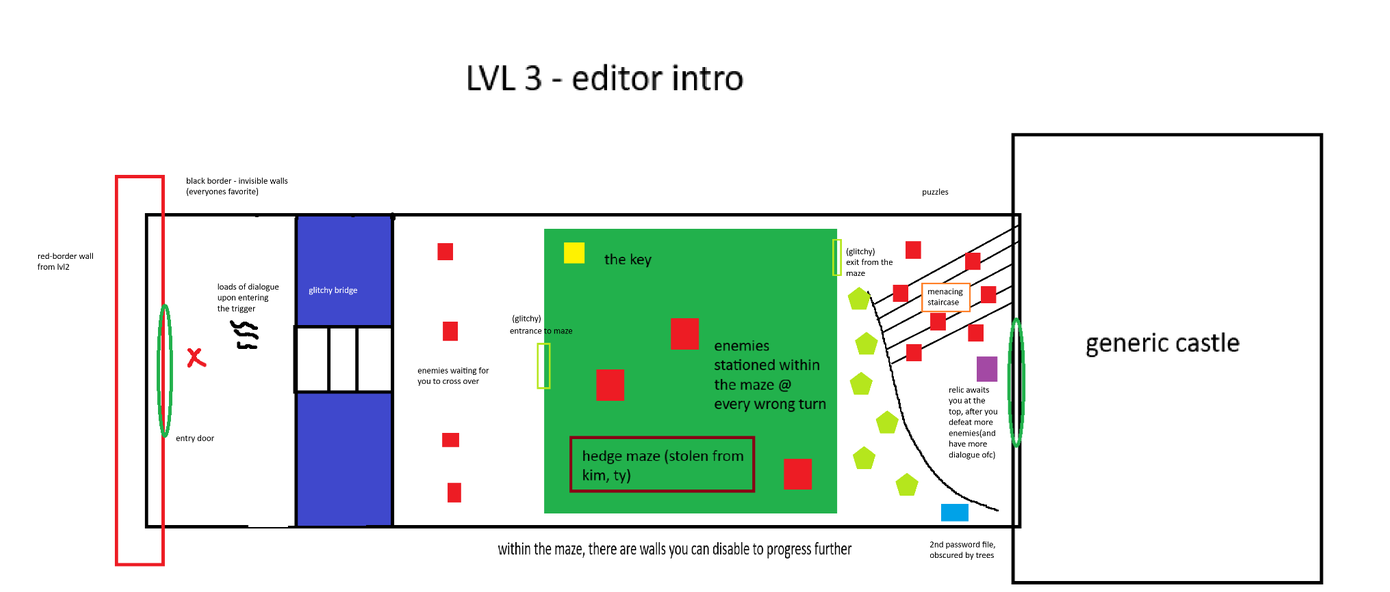
The original layout for Lvl3, majority was scrapped due to scope
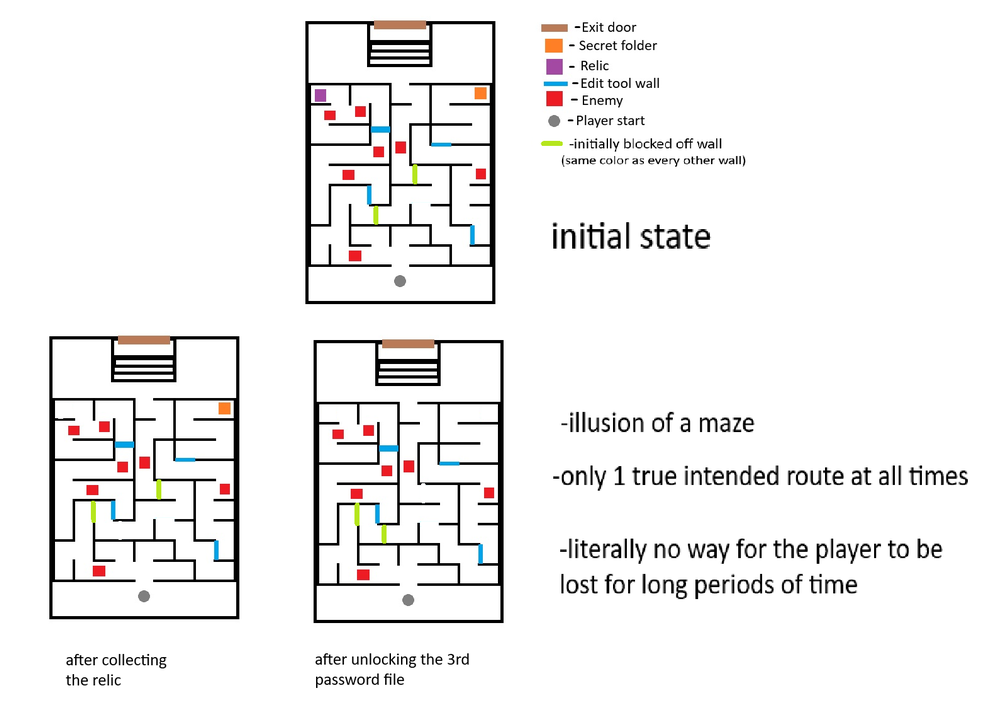
Finalised top down of Lvl3, primary focus is the faux maze